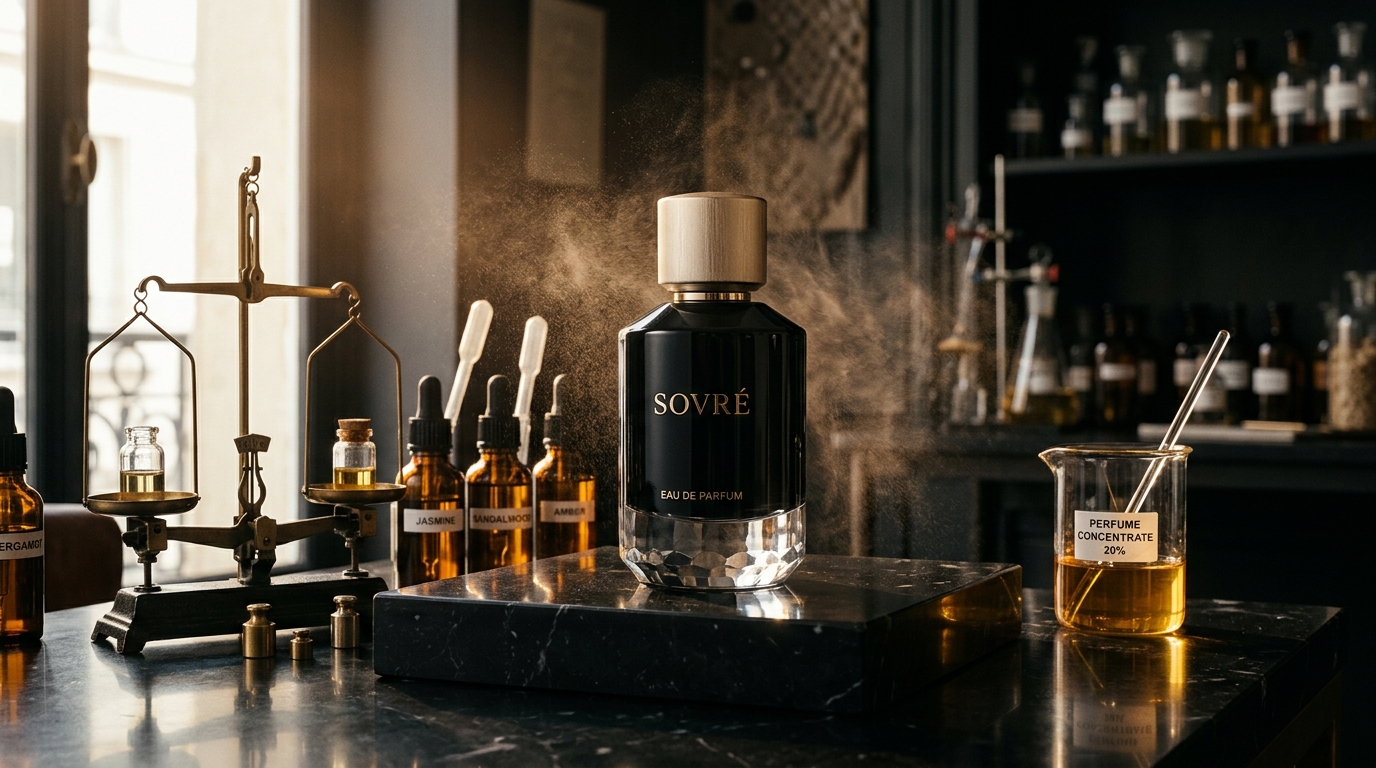
Eau de Parfum, Explained
Walk into a perfume store and you'll quickly encounter labels like Eau de Parfum, Eau de Toilette, Parfum, and Eau de Cologne.
For many people, they sound like different levels of the same thing.
And that's partly true — but not in the way most people think.
One of the biggest misconceptions in fragrance is that Eau de Parfum simply means "better perfume."
It doesn't.
These terms primarily describe different fragrance formats and typical concentration ranges. They can influence how a fragrance feels, projects and wears, but they don't tell you everything about the quality of the composition.
So what exactly is Eau de Parfum? Let's break it down.
What Does Eau de Parfum Mean?
Eau de Parfum, commonly abbreviated as EDP, is a type of fragrance formulation that typically contains a higher concentration of aromatic materials than Eau de Toilette.
The aromatic materials are diluted in a carrier, commonly alcohol, with the exact formulation varying between products and fragrance houses.
Unlike a simple strength scale, however, EDP is not a guarantee of how long a fragrance will last.
A fragrance's performance depends on much more than the label on its bottle. The ingredients, formulation, fragrance structure, skin chemistry and environment can all influence the final experience.
This is why two EDPs can behave completely differently on skin. One might feel light and airy. Another might be rich, dense and powerful. Both can still be Eau de Parfum.
EDP vs EDT vs Parfum vs Cologne
The easiest way to understand fragrance concentrations is to compare them.
| Fragrance Type | Typical Character | Common Use |
|---|---|---|
| Eau de Cologne (EDC) | Light, fresh | Refreshing, casual wear |
| Eau de Toilette (EDT) | Light to moderate | Daytime, everyday wear |
| Eau de Parfum (EDP) | Moderate to rich | Everyday through evening |
| Parfum / Extrait | Rich, concentrated | Special occasions, intimate wear |
These are general industry conventions, not rigid universal rules.
The fragrance industry does not use one globally fixed percentage system that makes every EDP, EDT or Parfum directly comparable. That distinction matters when shopping for perfume.
What Is the Difference Between EDP and EDT?
The most common comparison you'll see is: Eau de Parfum vs Eau de Toilette.
EDP generally contains a greater proportion of fragrance concentrate than EDT, although exact concentrations vary. That can result in a richer or more persistent fragrance experience.
But here's the part people often miss:
EDP doesn't automatically last longer than every EDT.
A fragrance's ingredients and formulation matter enormously.
For example, a composition dominated by highly volatile citrus notes may fade relatively quickly even in an EDP format. Meanwhile, an EDT built around woods, musks or other persistent materials can remain noticeable for considerably longer.
So instead of thinking: EDP = strong and EDT = weak, think:
EDP and EDT are different formulation formats that can create different fragrance experiences.
What Is the Difference Between EDP and Parfum?
Parfum, sometimes called Extrait de Parfum, generally represents a more concentrated fragrance format than EDP.
It can provide a denser and more intimate scent experience.
Interestingly, higher concentration doesn't necessarily mean greater projection. A highly concentrated Parfum can sit closer to the skin while remaining detectable for a long time. An EDP may project more noticeably into the surrounding air.
This is why longevity and projection should not be treated as the same thing.
Longevity vs Projection: What's the Difference?
These words are often used interchangeably, but they describe different physical and olfactory dynamics:
Longevity
How long the fragrance remains perceptible on your skin. If you can still detect molecular traces hours after spraying, that is longevity.
Projection
How far the scent radiates into physical space. An expansive projection reaches people across a room; an intimate projection stays within personal space.
Sillage
The scented vapor trail left behind as you move through space. A signature aura that marks your presence even after you have departed.
A perfume can have excellent longevity but relatively low projection. Another can project strongly during its opening but fade much sooner. That's why simply asking:
“How long does EDP last?”
doesn't tell the entire story.
Does Eau de Parfum Last Longer?
Often, but not always.
EDP formulations can contain more fragrance concentrate than EDT formulations, which can contribute to longer wear.
However, longevity depends on the complete formula. Factors include:
- Concentration
- Fragrance materials
- Note structure
- Skin chemistry
- Skin oil levels
- Temperature
- Humidity
- Application technique
- Whether it is applied to skin or clothing
A fragrance built around persistent base materials such as woods, musk or amber accords may behave differently from a fragrance centered around bright citrus or aquatic notes.
So when you're looking for a long lasting perfume, don't look at "EDP" alone. Look at the whole composition.
Why Does the Same Fragrance Come in EDP and EDT?
Sometimes fragrance houses release different concentrations of a similar scent.
Why? Because people want different experiences.
- An EDT can feel lighter, brighter and easier for daytime environments.
- An EDP can provide a deeper or more substantial version of the composition.
- A Parfum may offer a richer, smoother or more intimate interpretation.
The differences aren't always simply: "More perfume oil."
The formulation itself can change. Different versions may have adjusted proportions of ingredients or even subtle differences in their compositions.
That means an EDT and EDP with the same fragrance name shouldn't automatically be assumed to smell identical.
When Should You Choose Eau de Parfum?
EDP is one of the most versatile fragrance formats. It can work particularly well when you want a noticeable fragrance without necessarily choosing the intensity of a highly concentrated Parfum.
Choose EDP for:
Everyday wear: When you want your fragrance to have a noticeable presence throughout your routine.
Evening wear: When you want something richer or more expressive.
Cooler weather: Richer compositions can feel especially comfortable when temperatures drop.
A signature scent: EDP can offer a useful balance between presence and versatility.
But don't treat these as rules. A fresh EDP can be excellent in warm weather. A woody EDT can work beautifully at night. A Parfum can be perfect for everyday wear.
Your fragrance should fit your preferences, not the other way around.
How Does Concentration Affect Perfume Price?
Concentration can influence price, but it isn't the only factor.
When you're paying for a fragrance, you're paying for much more than the liquid inside the bottle. The final price can reflect:
- Fragrance materials
- Formulation and development
- Concentration
- Packaging
- Bottle design
- Brand positioning
- Marketing
- Distribution
- Retail costs
This is why two fragrances with similar sizes and concentration labels can have very different prices.
A higher price doesn't automatically mean a better fragrance. Likewise, a lower-priced fragrance isn't automatically inferior.
The real question is: What are you getting for the price you're paying?
For a deeper look at this, explore our comprehensive guide to perfume craftsmanship and fragrance classification.
Does Higher Concentration Mean Better Quality?
No.
This is probably the most important thing to understand.
Concentration and quality are different measurements.
Imagine two fragrances:
- Fragrance A is an EDP with a beautiful, balanced composition that develops smoothly from its opening through its dry-down.
- Fragrance B is a highly concentrated Parfum but has a composition you personally dislike.
Which one is better? There isn't a universal answer.
The best perfume is not necessarily the strongest perfume. And the most expensive perfume isn't necessarily the best-made perfume.
Quality is influenced by the composition, materials, construction, consistency and — ultimately — whether the fragrance achieves what it is designed to do.
How to Test an Eau de Parfum Properly
Don't make your decision immediately after spraying. Give the fragrance a chance to evolve.
Step 1 — Smell the opening
Notice your immediate reaction. Is it fresh? Sweet? Spicy? Floral? Woody? Clean? Smoky?
Step 2 — Wait
Give it some time. The initial burst will begin to settle and the heart of the fragrance will become more apparent.
Step 3 — Experience the dry-down
This is where the fragrance can become completely different from its opening. Look for the materials and accords that remain closest to the skin.
Step 4 — Decide
Ask yourself: "Do I actually enjoy the fragrance after it has developed?" That's a much better test than simply asking whether you liked the first spray.
EDP in Different Environments
Your environment can change how a fragrance behaves.
In warmer conditions, fragrance can evaporate and project more quickly. In cooler conditions, the same composition may feel more restrained. Humidity can also change the way fragrance is perceived.
This is especially relevant when choosing perfume for different climates. A fragrance that feels perfectly balanced in an air-conditioned environment may feel much more powerful outside on a hot day.
So when choosing an EDP, think beyond: "How strong is it?" Consider: "Where am I going to wear it?"
Common Eau de Parfum Myths
EDP Is Always Better Than EDT
False. They are different fragrance formats. Your preference, routine, and aesthetic should determine which one you choose.
EDP Always Lasts Longer
Not necessarily. Concentration can influence longevity, but base ingredients, molecular weights, and formulation are equally important factors.
Parfum Always Projects More
False. Concentration and projection aren't the same thing. Many highly concentrated pure extraits are formulated specifically to remain an intimate skin aura.
More Expensive Means Higher Concentration
Not necessarily. Price reflects raw material rarity, atelier craft, bottle packaging, brand positioning, and marketing scale.
Stronger Perfume Is Higher Quality
No. A fragrance can be delicate, understated, and exceptionally well constructed. Performance and projection are not synonyms for quality.
So, Which Fragrance Concentration Is Right for You?
There's no universal winner.
Choose EDT If:
- You want a lighter fragrance experience
- You need something easy for daytime
- You prefer a fresh, casual feeling
- You want moderate, controlled projection
Choose EDP If:
- You seek all-day versatility
- You want a richer fragrance experience
- You value good presence without being overwhelming
- You need a scent that transitions from day to night
Choose Parfum If:
- You want maximum concentration
- You appreciate deeper, resinous complexity
- You desire an intimate, close-to-skin wear
- You want something distinct for special occasions
And if you love a particular scent in EDT? Wear the EDT. If you prefer its EDP version? Wear the EDP.
There is no fragrance rulebook saying you have to choose the more concentrated version.
The SOVRÉ Perspective
At SOVRÉ, we don't believe fragrance should be reduced to a percentage printed on a bottle.
Concentration matters. But so do the materials, composition, evolution and atmosphere surrounding the scent.
A fragrance is experienced over time. The opening introduces it. The heart reveals it. The dry-down leaves the impression.
That is why we believe choosing a fragrance should be less about finding the "strongest" option and more about finding the composition that feels right for your presence.
“Because ultimately, perfume isn't about how much fragrance you wear. It's about what remains after you've left.”
Frequently Asked Questions
No. Eau de Parfum generally represents a different concentration format from Eau de Toilette, but concentration does not automatically determine fragrance quality.
It can be, but longevity varies significantly depending on the formulation, ingredients, skin chemistry and environment.
EDP often has greater longevity than EDT, but there are no absolute rules. A well-formulated EDT can outlast an EDP depending on its materials and composition.
Parfum generally has a higher concentration of fragrance materials, but that doesn't necessarily mean stronger projection. It can instead create a richer and more intimate experience.
Yes. EDP is one of the most versatile fragrance formats and can work well for everyday, professional and evening wear depending on the specific composition.
Choose based on the fragrance itself, your preferred intensity, the occasion and your environment. Don't choose solely because one label sounds "stronger."
Final Thoughts
The next time you see EDP on a perfume bottle, don't simply translate it as: "stronger perfume."
Think about the complete picture:
- Concentration.
- Composition.
- Fragrance family.
- Projection.
- Longevity.
- Skin.
- Climate.
And most importantly, how the fragrance makes you feel.
Because the right perfume isn't necessarily the one with the highest concentration.
It's the one that becomes part of your presence.
Discover Your Signature Scent
Explore SOVRÉ's fragrance collection and find the Eau de Parfum that speaks in your language.