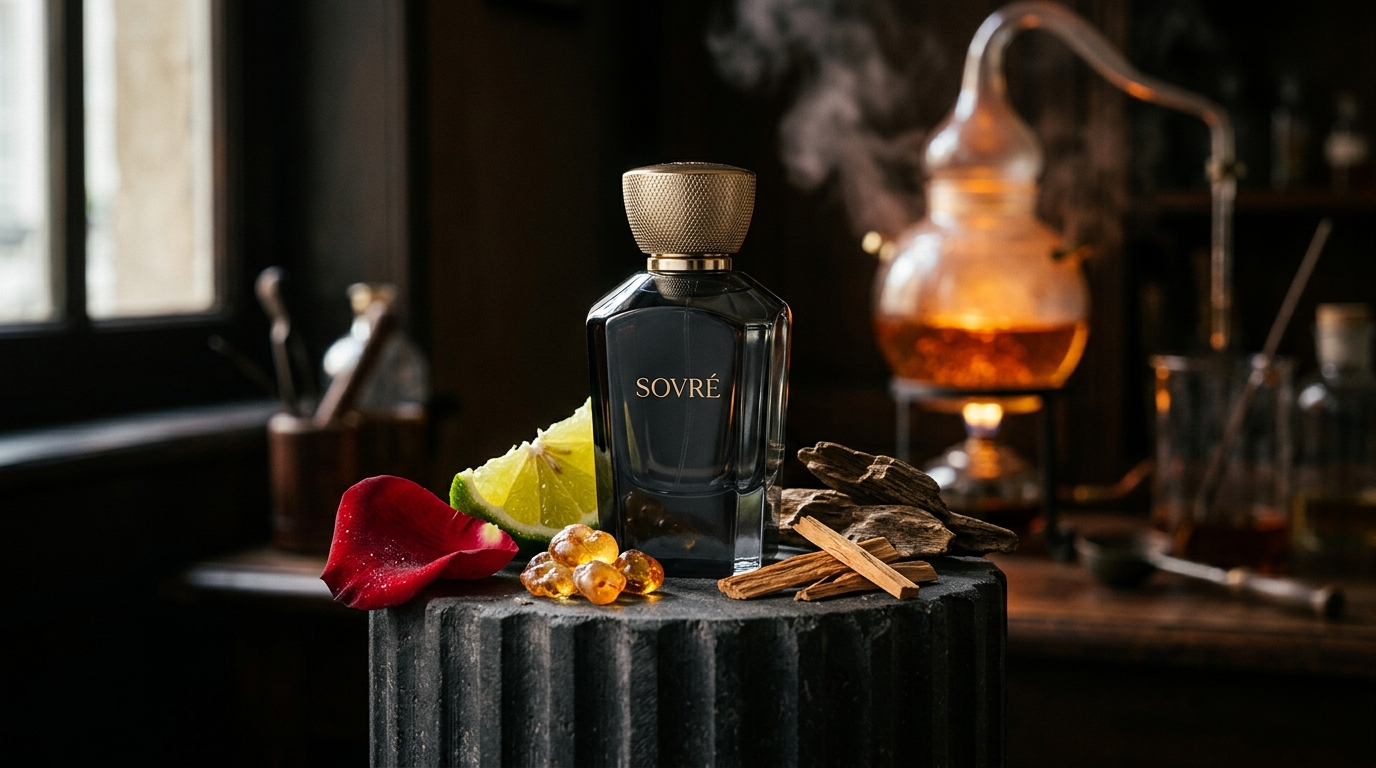
What Perfume Actually Is — Beyond the Marketing
Perfume is more than a pleasant smell in a bottle.
It is a composition of aromatic materials designed to evolve over time, interact with the wearer, and create an experience that can be surprisingly personal. Two people can wear the same fragrance and experience it differently. The same perfume can also feel completely different in the first few minutes than it does several hours later.
That is why choosing a perfume based only on a bottle, an advertisement, or a list of "best perfumes" can be misleading.
A better approach is to understand how fragrance works.
Once you understand fragrance families, concentration, notes, projection, dry-down, and skin chemistry, choosing a perfume becomes less about guessing and more about knowing what you like.
This guide breaks down the essentials — from how a fragrance develops on skin to what actually separates a luxury perfume from an ordinary one.
The Olfactory Pyramid: Top, Heart, and Base Notes
When you first spray a perfume, you aren't necessarily smelling the complete fragrance.
A perfume is designed to unfold in stages. These stages are commonly described using the olfactory pyramid:
The Architecture of Evaporation
Molecular weights govern the unfolding rate of botanical and synthetic aromatic essences.
Top Notes
The initial, highly volatile impression. Creates the immediate spark upon atomization before evaporating into the heart.
Heart Notes
The emotive personality of the composition. Emerges as the volatile citrus and herbal notes soften.
Base Notes
Dense molecular structures that anchor the perfume to skin sebum and textiles. Forms the dry-down memory.
Top Notes
Top notes are the first impression.
They are generally composed of more volatile materials that evaporate relatively quickly. Common examples include:
- Bergamot
- Lemon
- Orange
- Grapefruit
- Lavender
- Mint
- Aromatic herbs
Top notes create the opening of a perfume — the moment when you first spray it and immediately form an impression. A citrus-heavy fragrance, for example, may open bright, sparkling and fresh before becoming warmer or more woody later.
Heart Notes
After the initial opening settles, the heart of the fragrance becomes more noticeable.
Heart notes form much of the character of the composition and can include materials such as:
- Rose
- Jasmine
- Iris
- Geranium
- Cardamom
- Cinnamon
- Fruity accords
This is often where the personality of the perfume becomes clearer. A fragrance that initially smells citrusy might gradually reveal a floral, spicy or aromatic character underneath.
Base Notes
Base notes form the deeper part of the composition and generally become more prominent as the fragrance dries down.
Common examples include:
- Sandalwood
- Cedarwood
- Patchouli
- Vetiver
- Musk
- Vanilla
- Amber accords
- Oud
These materials can contribute to the depth and persistence of a fragrance.
The important thing to remember is that the pyramid isn't three completely separate perfumes appearing one after another. Fragrance materials overlap and interact throughout the wearing experience.
Think of it more like a piece of music: different elements become more noticeable as the composition develops.
How a Perfume Changes Over Time
The first spray isn't the final version of the fragrance.
A useful way to understand perfume is through three moments:
Opening
The immediate encounter. High volatility elements establish immediate attention and crisp character.
Heart
Develops as lighter molecules dissipate. The signature body and emotional texture emerge.
Dry-Down
The intimate residual sillage left on skin hours later, anchored by deep resins, woods, and musks.
The opening is what you encounter immediately. The heart develops as the more volatile materials begin to fade. The dry-down is what remains after the fragrance has spent time on your skin.
This is one reason smelling a perfume only from the bottle can be unreliable.
“Allow a fragrance time to develop on skin rather than judging it solely from the bottle.”
— Michael Edwards, Fragrances of the WorldAt SOVRÉ, this distinction matters.
A fragrance isn't simply an opening note.
It is the journey from the first impression to the final trace left behind.
Fragrance Concentrations Explained
One of the first things you will notice when shopping for perfume is terminology such as:
- Eau de Cologne
- Eau de Toilette
- Eau de Parfum
- Parfum
- Extrait
These terms generally describe fragrance products with different typical concentrations, but there is an important misconception to clear up:
Eau de Parfum does not automatically mean "better" than Eau de Toilette. The terminology is not a universal quality ranking.
IFRA (International Fragrance Association) notes that terms such as Eau de Toilette, Eau de Parfum and Eau de Cologne are commonly used descriptors rather than universally fixed international definitions based strictly on concentration. Typical industry ranges vary.
Eau de Cologne
Typical: 2% – 5% OilLighter in concentration. Commonly associated with fresh, bright compositions; exceptionally easy and refreshing for warm conditions.
Eau de Toilette
Typical: 5% – 15% OilSits above Cologne. Works beautifully for daytime wear, offices, and situations where controlled projection is preferred.
Eau de Parfum
Typical: 15% – 20% OilMore concentrated format. One of the most common standards for fine modern perfumery, balancing presence with everyday wearability.
Parfum / Extrait
Typical: 20% – 35%+ OilThe pinnacle of density and persistence. Offers great depth and intimate skin longevity without synthetic screech.
Eau de Cologne — EdC
Eau de Cologne is typically lighter in concentration. It is commonly associated with fresh, bright compositions and can be particularly appealing when you want something easy and refreshing.
Eau de Toilette — EdT
Eau de Toilette generally sits above Cologne in typical fragrance concentration. It can work beautifully for daytime wear, warmer conditions and situations where you don't necessarily want an intense projection.
Eau de Parfum — EdP
Eau de Parfum is typically more concentrated than Eau de Toilette. It is one of the most common formats for modern fine fragrance and can provide a balance between presence and wearability.
But concentration alone doesn't determine how long a fragrance lasts. The formula, ingredients, fragrance family, skin and environment all matter.
Parfum / Extrait
Parfum and Extrait generally refer to more concentrated fragrance formats. They can offer greater depth and persistence, although again, higher concentration does not automatically mean better quality or dramatically longer wear.
A well-formulated fragrance at a lower concentration can outperform a poorly constructed fragrance at a higher one. That distinction is important.
Does Concentration Determine Longevity?
Not completely.
It is tempting to think of perfume like this:
More concentration = more longevity = better perfume.
Real fragrance is more complicated.
IFRA's own documentation emphasizes that fragrance ingredients and their permitted use levels are considered within specific product categories and safety frameworks rather than being governed by a single universal concentration definition.
Longevity can be influenced by:
- Fragrance concentration
- The materials used
- The structure of the composition
- Skin characteristics
- Temperature
- Humidity
- Application method
- Clothing versus skin
This is why two Eau de Parfums can behave completely differently. One may disappear relatively quickly. Another may remain detectable many hours later.
The label tells you something. It doesn't tell you everything.
The Major Fragrance Families
If concentration tells you something about the format of a fragrance, fragrance families help explain its character.
Michael Edwards' Fragrance Wheel is one of the best-known systems for understanding relationships between fragrance families. His classification system includes major families and numerous subfamilies that help organize the enormous world of perfume.
Rather than memorizing every category, begin with the broad characteristics.
Floral
Built around floral impressions. Floral doesn't necessarily mean delicate; it can be fresh, powdery, dark, creamy, spicy or sensual depending on surrounding materials.
Woody
Emphasizes materials and accords associated with woods. Compositions can feel dry, smooth, smoky, earthy or creamy. Often associated with architectural sophistication.
Amber
Explores warmth, sweetness, resinous textures, and sensual depth. Resins, spices, and warm woods create effects ranging from softly sweet to rich and nocturnal.
Fresh
Focuses on brightness and clarity. Citrus, green, aquatic, and aromatic effects evoke energy and effortless clean posture throughout daytime hours.
Chypre
A distinctive architectural structure traditionally contrasting fresh citrus openings with deep woody, mossy, and earthy foundations. Elegant and complex.
Gourmand
Creates edible or dessert-like impressions without necessarily being sugary. Master compositions balance sweetness with smoky woods, coffee, and spices.
Michael Edwards' current Fragrance Wheel further divides fragrance into families and subfamilies such as Fresh, Floral, Amber and Woody, illustrating how different scent styles relate to one another.
What Is the Most Popular Perfume?
There is no single answer.
Popularity depends on where, when and among whom you measure it.
A perfume can be popular because of:
- Brand recognition
- Advertising
- Celebrity association
- Availability
- Price
- Social media trends
- Word of mouth
- Longevity
- A distinctive signature
But popularity and quality are not the same measurement. The fragrance that sells the most isn't necessarily the fragrance that suits you best.
That is why SOVRÉ approaches perfume through fit rather than hype.
The better question isn't: “What is the world's best perfume?”
It is: “What kind of fragrance works best for me?”
Which Perfume Is Best for Everyday Use?
For everyday wear, versatility usually matters more than intensity.
A fragrance that works for a morning class, office, coffee, lunch and an evening out can become significantly more useful than a fragrance designed exclusively for one occasion.
For everyday perfume, consider:
Projection
How far the fragrance radiates from your skin.
Longevity
How long the fragrance remains perceptible.
Versatility
Whether the scent works across different environments.
Comfort
Whether you genuinely enjoy smelling it for several hours.
Climate
Temperature and humidity can influence how a fragrance projects and feels.
There is no universal "best everyday perfume." A fresh citrus composition might make sense for one person. A clean musk might work for another. Someone else might prefer a woody or softly amber fragrance.
Your lifestyle should influence your fragrance wardrobe.
Why the Same Perfume Smells Different on Different People
You may have noticed this before.
Someone wears a perfume. You smell it on them and love it. You buy the same fragrance. And somehow, it doesn't smell quite the same.
That's normal.
Fragrance interacts with the skin and its environment. Skin warmth, oil levels and other individual factors can influence how a composition develops and how long it remains noticeable.
Even Michael Edwards recommends testing fragrance on skin because a fragrance can develop differently there than it does when smelled directly from an opened bottle.
Instead of the impulse method:
Spray → sniff → buy.
Adopt the true testing discipline:
Spray → wait → experience → decide.
Give the fragrance time to develop. The perfume you love after ten minutes may not be the perfume you love after four hours. And sometimes the opposite is true.
Perfume Myths Worth Forgetting
More Expensive Means Better
Price reflects ingredients, packaging, distribution, brand positioning, marketing, and scale. Luxury pricing does not automatically guarantee a superior fragrance.
Stronger Means Higher Quality
A fragrance can project aggressively and still be poorly constructed or cloying. Likewise, an intimate, subtle composition can be constructed with exquisite master craft. Performance and quality are different concepts.
Eau de Parfum Always Lasts Longer
While higher concentration often contributes to persistence, formulation, base ingredients, and volatility govern true wear. IFRA specifically notes that concentration labels do not have universally fixed standards.
Perfume Has to Be "Masculine" or "Feminine"
Fragrance marketing has traditionally divided products into gendered categories, but scent itself has no gender. Woody, floral, amber, musk, and citrus materials belong to whoever enjoys wearing them.
You Should Rub Your Wrists Together
Rubbing your wrists produces friction, alters skin temperature, and disrupts the natural volatile evaporation curve. Simply spray and let it settle undisturbed.
How to Actually Choose Your Perfume
Instead of searching endlessly for a "best perfume," use a simple process.
Start With Your Preferred Family
Ask yourself what naturally attracts you. Start with what you enjoy smelling rather than memorizing technical jargon:
- Fresh? Citrus, aquatic, green and aromatic.
- Floral? Rose, jasmine, iris and white flowers.
- Woody? Sandalwood, cedar, vetiver and patchouli.
- Warm? Amber, vanilla, spices and resins.
- Gourmand? Coffee, chocolate, caramel and sweet accords.
Consider the Occasion
Your fragrance doesn't exist in isolation. Consider where you will be wearing it:
- Daytime: Fresh, clean and moderate compositions work beautifully.
- Office: Controlled projection ensures the scent doesn't dominate shared rooms.
- Evening: Warmer, deeper, or more expressive compositions make sense.
- Special Occasions: Choose something memorable, distinctive, and luxurious.
Consider the Weather
Climate fundamentally transforms fragrance behaviour. Heat amplifies volatility and projection, while cold contracts it. Ask: "What perfume performs appropriately in my environment?"
Test It on Skin
Don't judge a perfume entirely from the bottle. Spray a small amount onto your skin and track the evolution:
- 0–15 minutes: What does the opening feel like?
- 1–2 hours: What is becoming more prominent?
- Several hours later: What remains?
You aren't just testing longevity. You're testing whether you enjoy the entire evolution.
How SOVRÉ Approaches Fragrance
At SOVRÉ, fragrance isn't treated as a popularity contest.
A perfume is an expression of presence.
We believe choosing a scent should begin with understanding it — its character, its structure, its environment and the feeling it creates when it becomes part of your day.
That means looking beyond labels such as "best," "strongest" or "most popular."
Instead, we ask:
- What does it smell like?
- How does it evolve?
- Where does it belong?
- How does it perform?
- And most importantly — does it feel like you?
“Because the right perfume doesn't need to announce itself loudly. Sometimes, it simply becomes part of the way people remember you.”
Frequently Asked Questions
Clear, direct answers to common questions about perfume formulation, concentration, and selection.
Perfume is a fragrance composition made from aromatic materials and formulated for application to the body or other intended uses. Its character comes from the interaction of different fragrance materials and how they develop over time.
Eau de Parfum is a commonly used fragrance concentration label, while "perfume" can be used more broadly or to refer specifically to more concentrated formats such as Parfum or Extrait. These labels are not universally fixed by one international concentration standard.
There isn't one universal answer. Longevity depends on concentration, formulation, materials, skin, application and environment. Fragrances built around deeper base materials can often remain noticeable for longer than compositions dominated by highly volatile fresh notes, but individual performance varies.
Apply a small amount to your skin and allow it time to develop. Don't judge the fragrance only from the bottle or immediately after spraying. Michael Edwards recommends giving fragrance time to bloom on the skin rather than relying solely on smelling it from the bottle.
Not automatically. A higher price can reflect ingredients, concentration, packaging, brand positioning, distribution and other costs. Price alone isn't a reliable measurement of fragrance quality.
The best everyday perfume is the one that fits your preferences, environment and routine. Versatility, comfortable projection and a fragrance profile you genuinely enjoy are usually more useful criteria than popularity alone.
The Final Note
Choosing perfume shouldn't feel like choosing the "correct" answer.
There isn't one scent that everyone should wear.
There are only compositions that fit — or don't fit — a particular person, moment and environment.
- Learn the families.
- Understand concentration.
- Test the dry-down.
- Pay attention to your skin.
- And stop chasing the idea of the universally "best" perfume.
Find the one that becomes unmistakably yours.
Discover Your Signature
Explore the SOVRÉ collection and find a fragrance designed not simply to be noticed, but to be remembered.